

Clouds, heard and felt

Most people are familiar with the typical fabric-wrapped wall panels and acoustical ceiling tiles that absorb sound and echo in office environments—and may also be familiar with the reverberant, unintelligible character of a room without these absorptive treatments.  However, the same absorption can always be provided in less traditional forms, delivering world-class design that just happens to have acoustic benefit as well.

In search of this sort of innovation on a recent visit to Copenhagen, we stopped by the Dansk Design Center, a museum and gallery showcasing the best in Danish industrial, product, and graphic design.  On display among the winners of the 2010/11 Danish Design Prize was a product called Clouds, produced by Kvadrat A/S and designed by Ronan and Erwan Bouroullec.  The product is a modular system of 2-D felt panels that are joined with rubber bands at the edges to form complex, striking 3-D surfaces and volumes.  The resulting felt sculptures can be fixed to walls, hung from ceilings, or form room dividers on their own.

Felt "Clouds", by Kvadrat A/S and Ronan & Erwan Bouroullec

Acoustically, felt is an effective absorber of high-frequency sound, and by trapping substantial air spaces within or behind the overall surface, low- and mid-frequency absorption is possible as well.  Products like this allow the acoustic treatment to form an attractive centerpiece to a space’s visual aesthetic, rather than blending into the background!

Ch-Ch-Ch-Chia Wall???

Chia HeadProbably at one time or another you had a Chia Pet or at least knew someone who did.  How about the Chia Car?  Well, the Ohio Department of Transportation has come up with an environmentally friendly, aesthetically pleasing sound barrier, the Chia Wall if you will.  The naturally “green” noise barrier will separate a residential neighborhood from a noisy next-door interstate and will be constructed of bags of soil and seeds – just add water.

Who let the dogs shout

This week the New York Daily News brings us the story of two Upper East Side dachshunds with the honor of bringing home the most animal noise citations of any household in the city last year.  After being warned, the pups’ owner had to cough up a total of $245 for the citations—and no word of what their tally might be so far in 2010.

Interestingly, the “most animal noise citations” for these dogs came to a grand total of: two citations!  Last year, the city Department of Environmental Protection issued only 22 citations for animal noise citywide, despite logging over 5,900 animal noise complaints to 311 that precipitated over 1,200 inspections.

Updated and expanded in 2007, section 24-235 of the New York City Noise Control Code prohibits owners from allowing animal noise to be “plainly audible” in another residence for more than 10 continuous minutes between 7 a.m. and 10 p.m., and more than 5 continuous minutes between 10 p.m. and 7 a.m.  Of course, for a citation to be issued, a DEP inspector needs to be present and witness the 5 or 10 minutes of continuous barking in person, which may explain the disparity between the number of inspections and actual citations: never a barking dog when you need one!

[via Gothamist]

Clean, green, noise machines

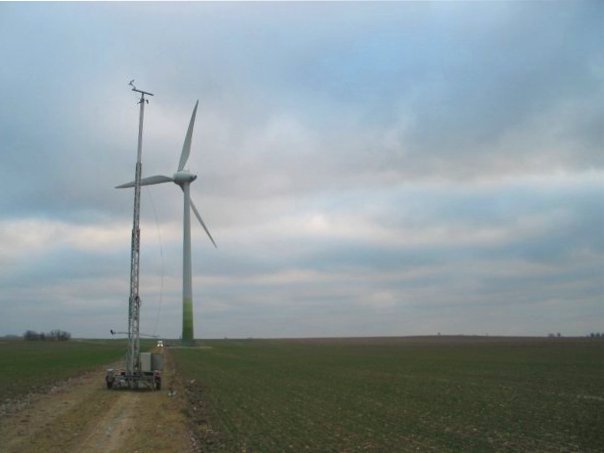
Those big, graceful wind turbine power plants dotting the countryside may be a great source of clean power, but they can also represent a source of noise and annoyance to their immediate neighbors.  In a quiet rural area, the whoosh-whoosh noise of a large turbine (some exceeding 300 feet from ground to wingtip) can be audible thousands of feet away.  Several recent epidemiological studies have shown that annoyance from wind turbine noise is greater than that from other environmental sources (such as highways) at an equal noise level.  This discrepancy is likely influenced by unrelated factors (e.g. blocked views), but the continuing push for green energy requires an equal effort to research wind turbine noise and its impact on the health of people nearby.

We recently published the results of a detailed wind turbine noise study in the peer-reviewed acoustics journal Acta Acustica, in conjunction with our colleagues at Chalmers University of Technology and the University of Gothenburg in Sweden. We approached the disparity in annoyance by starting at the source: investigating the accuracy of methods for predicting the noise from a wind turbine in the first place.  Such methods are the basis for designing and regulating wind turbine sites, but necessarily simplify complex factors such as wind and temperature influence on sound.

After an extensive campaign of hundreds of field measurements (in the beautiful Skåne countryside) and days of computer simulation, we found that at a relatively short receiver distance, wind and similar factors were not significantly affecting the sound transmission path—the turbines are simply too tall for wind to influence levels nearby on the ground.  Instead, wind and temperature fluctuation influence the amount of noise generated at the turbine itself, and may do so in ways that aren’t always accounted for in current prediction methods.  As always, further research is needed!

Wind turbine

Wind turbine noise measurement in Skåne, southern Sweden

New York State Women-Owned Business Enterprise (WBE)

We are happy to announce that lally acoustical consulting is now certified with the New York State Division of Minority and Women Business Development as a Women-Owned Business Enterprise (WBE)!

NY loves WBE

Too much noise? No, too little silence

In a recent op-ed piece for the New York Times, author and silence activist George Prochnik eschews ranting about noise in favor of cultivating “a passionate case for silence.”  Prochnik (whose recent book “In Pursuit of Silence” further explores this theme) suggests that doom-and-gloom about noise and its well-documented health effects may be losing traction with a public weary of “self-compassion”.  Indeed, despite noise being the number one environmental complaint in New York City year after year, last week’s International Noise Awareness Day offered its hometown little more than free hearing tests behind City Hall.

Prochnik’s perspective is an intriguing one, and he finds promise in efforts to integrate “oases of quiet” into the urban soundscape.  Referencing Swedish research on urban environmental noise (to which we have directly contributed), he reminds us that noise control efforts that are nearly futile along busy urban streets can rather create truly quiet, healthful “quiet sides” in backyards and courtyards between buildings.

Of course, this approach is neither Swedish nor new— pre-war neighborhoods in Manhattan are chock full of residential buildings boasting sheltered courtyards—but Prochnik reminds us that this luxury is not often afforded to residents of disadvantaged areas.  Not to mention, courtyards that may have provided a quiet oasis in pre-air-conditioning days now carry the modern acoustical burden of concealing scores of unsightly air-conditioning units—often giving these New York City courtyards the irony of being as noisy as the streets they defend against.