

Archive for July, 2010

Who let the dogs shout

This week the New York Daily News brings us the story of two Upper East Side dachshunds with the honor of bringing home the most animal noise citations of any household in the city last year.  After being warned, the pups’ owner had to cough up a total of $245 for the citations—and no word of what their tally might be so far in 2010.

Interestingly, the “most animal noise citations” for these dogs came to a grand total of: two citations!  Last year, the city Department of Environmental Protection issued only 22 citations for animal noise citywide, despite logging over 5,900 animal noise complaints to 311 that precipitated over 1,200 inspections.

Updated and expanded in 2007, section 24-235 of the New York City Noise Control Code prohibits owners from allowing animal noise to be “plainly audible” in another residence for more than 10 continuous minutes between 7 a.m. and 10 p.m., and more than 5 continuous minutes between 10 p.m. and 7 a.m.  Of course, for a citation to be issued, a DEP inspector needs to be present and witness the 5 or 10 minutes of continuous barking in person, which may explain the disparity between the number of inspections and actual citations: never a barking dog when you need one!

[via Gothamist]
Clean, green, noise machines

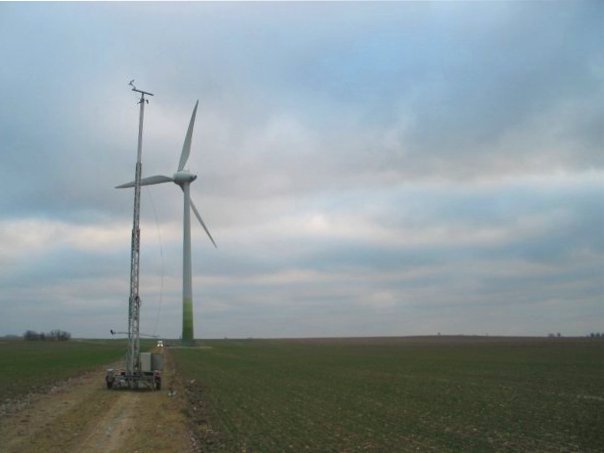
Those big, graceful wind turbine power plants dotting the countryside may be a great source of clean power, but they can also represent a source of noise and annoyance to their immediate neighbors.  In a quiet rural area, the whoosh-whoosh noise of a large turbine (some exceeding 300 feet from ground to wingtip) can be audible thousands of feet away.  Several recent epidemiological studies have shown that annoyance from wind turbine noise is greater than that from other environmental sources (such as highways) at an equal noise level.  This discrepancy is likely influenced by unrelated factors (e.g. blocked views), but the continuing push for green energy requires an equal effort to research wind turbine noise and its impact on the health of people nearby.

We recently published the results of a detailed wind turbine noise study in the peer-reviewed acoustics journal Acta Acustica, in conjunction with our colleagues at Chalmers University of Technology and the University of Gothenburg in Sweden. We approached the disparity in annoyance by starting at the source: investigating the accuracy of methods for predicting the noise from a wind turbine in the first place.  Such methods are the basis for designing and regulating wind turbine sites, but necessarily simplify complex factors such as wind and temperature influence on sound.

After an extensive campaign of hundreds of field measurements (in the beautiful Skåne countryside) and days of computer simulation, we found that at a relatively short receiver distance, wind and similar factors were not significantly affecting the sound transmission path—the turbines are simply too tall for wind to influence levels nearby on the ground.  Instead, wind and temperature fluctuation influence the amount of noise generated at the turbine itself, and may do so in ways that aren’t always accounted for in current prediction methods.  As always, further research is needed!

Wind turbine

Wind turbine noise measurement in Skåne, southern Sweden